Platform
Who it's for
The ASX has a new CEO, he is 3 weeks in and already making big plays.
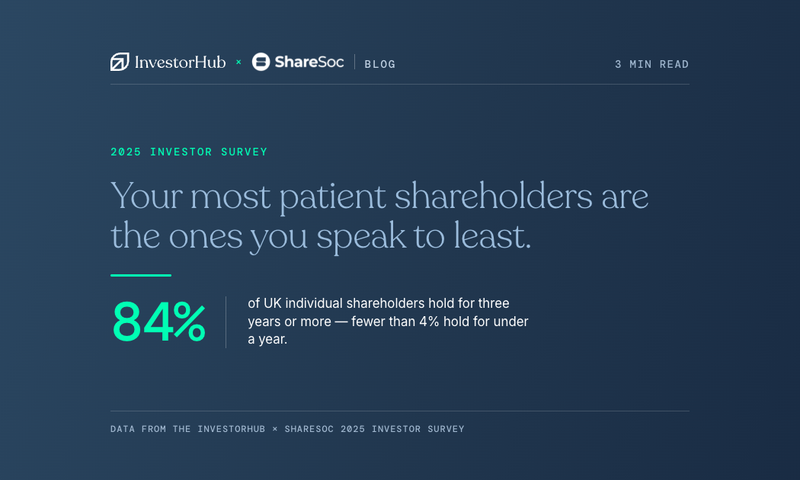
Ask most people in the City how long an individual investor holds a stock and you'll get an answer measured in weeks. We tested that assumption with ShareSoc, and it isn't close: 84% of the UK individual shareholders we surveyed hold for three years or more, and fewer than 4% hold for less than a year. The biggest positions sit with the most patient holders. Yet nearly two-thirds say an annual webinar isn't enough to stay informed, and four in five want contact at least quarterly. Your longest-standing shareholders are the ones you speak to least.
Exits aren't the failure; the price is, and that's on us.
I'm no insto. I haven't got a great track record. Here's why you still want my money.
A question about how UK boards are structured.
Investors are running your results through AI before they read them properly. Here's what that changes.
The significance of the capital access window should not be understated.
What would a second exchange mean for you?
More investors watching means more investors buying.
Brokers are tapped out and paid investor events draw the same faces. Why issuers should skip the middleman and host their own events together.
If you're high-growth, R&D-heavy or an explorer, there is no easy multiple for the market to anchor to. Investors are backing two things instead: a story they can understand, and a team they can see.
Most of your investors are not professionals in your field, and if you only speak to the ones who already understand you, you're ignoring 99% of the public. The two answers to closing the gap between where you are and how you're priced: education and trust.
Your work today won't turn into reported results for months, so the market often prices where you were, not where you are. A prompt to think about how big that gap is for your company, and how you communicate it.
SpaceX debuted on the Nasdaq up 19% in the largest IPO in history, while $8m Canberra defence tech company Boresight listed up 90% on the ASX. Two ends of the market, same result: the IPO window is looking healthy.
A newly dual-listed Canadian lithium company released a Corporate Governance Statement with a garbled, accidental sentence on page one. What likely happened, and the simple AI review step that stops it happening to you.
Hedge funds run AI over your announcements and trade before human analysts finish reading. Now larger companies are fighting back by pressure-testing their own releases, and the arms race is moving down the market.
The budget is pushing investors out of family trusts and into holding companies, which will steadily erode how well you know your register. Why that matters for the mid-register buyers who drive your share price, and what to do now.
Listed life comes in waves: macro shocks, micro setbacks and a marketing landscape that keeps shifting. Borrowing a lesson from champion surfer Layne Beachley on separating what you can control from what you can't.
Elite sport and listed life share a public scoreboard and constant friction. A stoic lesson, and the story of an MD who beat a 249D board spill by leaning in, show why pressure is the medium of the job, not an interruption to it.
Allbirds sold its core shoe business, pivoted into AI, and jumped more than 700% intra-day. Behind the spectacle is a lesson every listed company can use: clarity drives confidence, and confidence drives buying.
After 19 intimate dinners with listed leaders, the most popular topic was being listed itself. The truth is it's both a blessing and a burden, and the best answer I heard was simple: either delist or lean into it.
The RBA governor's speech on AI raised a war of technology between the buy and sell side, while large caps cut thousands of jobs in the name of AI efficiency. I read those cuts very differently.
RIU Fremantle was packed, and ASX data shows money flowing back into IPOs, raises and daily volume. A reminder that when capital starts flowing again, it flows disproportionately to the teams investors already trust.
Roadshow slots are limited and tiring to fill. Adding a group drinks session or lunch to the end of your roadshow, and asking HNW investors to bring a +1, is a cheap way to multiply the reach of an expensive trip.
AI is flooding our feeds with content that is getting harder to tell from the real thing. My prediction is that this erosion of trust will push investors towards live video, webinars and in-person events.
IPOs are up 59% year on year, with 62 new listings in the six months to December. The biggest risk now is companies treating the IPO as the end of the process rather than the beginning.
Every recent capital raise seems to be oversubscribed and covered within hours. The market is back, and the next month is the perfect time to plan how you'll capture that capital in 2026.
With international exchanges circling Australia, the ASX's best defence is winning the loyalty of its listed companies. Three ideas it could implement now, starting with hiring more people to look after them.
Six-week windows make the market look grim while 12-month numbers tell a different story. Behind the swings: more capital entering the ASX, 40% more trades, and smaller parcels, which adds up to a bigger market with more opportunity.
Pitching one-on-one is still the best way to tell your story, but webinars let you scale it. Three levels of webinar strategy, with real examples from Airtasker, Cogstate, and Coda Minerals.
Four words from a director in Peppermint Grove that capture the shift from executive to non-executive life: stay close enough to know what's happening, but keep your hands off the engine.
AI can save time across IR workflows, but using it to fake authenticity breaks the trust investors are actually buying. Where AI helps, and the one place it should never go.
After months of rising volumes and packed conferences, retail and HNW investors are coming back to the market. For anyone outside the ASX 200, they are the majority of your volume and they own your share price.
ASX Aware Letters have jumped from fewer than 2 a year to 28 so far in 2025 for ASX 200 companies. Two forces are behind it: AI-driven hedge fund traders and greed-and-fear retail trades.
Two Chanticleer articles in the AFR this week covered ASX200 speeding tickets and the rise of retail investors as friendly, high-conviction buyers. What they mean for how you run investor relations.
Reporting season may be behind you, but storytelling never stops. Three frames of reference for keeping investors engaged: treat results as a milestone, bring holders together, and scale your answers to common questions.
Two founder-led tech stocks took very different approaches to presenting FY results: Kogan's AI voice avatars and Xref's slide-by-slide founder videos. Both have their place, and one might be a new best practice.
A proven marketing framework applied to IR: do more of what's working with your existing shareholders, improve what you're already doing, and only then add new initiatives.
Listed rules can feel constrictive, but being listed gives you a distribution network most private companies would kill for. A reframe on the cost of compliance and the audience it buys you.
The 3M's that drive share price performance need a fourth: momentum. Why good announcements flop without it, and how to build it strategically between major updates.
Daily ASX volume is up, Noosa was packed, and Figma's IPO jumped 250% on day one. When investors make money they reinvest, and that momentum rewards companies that are visible and ready.
Three days at the Noosa Mining Conference, the busiest I've seen it in five visits. With 5% of the ASX in one room and serious HNW and family office money in the crowd, the market is moving again.
The ASX's June activity report shows $7.07 billion in daily on-market trading, up 17% year-on-year, with smaller parcels and more trades. Retail and HNW investors are driving the action, and that has big implications for your liquidity.
Most listed companies treat their shareholder base like a static list: post to the ASX, assume it was read, and move on. The best IR teams build feedback loops that listen, test, and iterate.
Investors don't fall in love with your stock, they fall in love with your story and the people behind it. How to build real relationships across your register, from the top 20 down to the long tail.
Investor relations is marketing: you're building a brand, telling a story, and driving an action. Every update and announcement is a brand signal, and if you don't define your brand, the market will do it for you.
AI has a real role in investor relations, but it's a tool, not a spokesperson. Where AI helps behind the scenes, and where it should never replace the human element.
Quick capital raises, rebrands, and last-minute roadshows relieve the pressure for a moment without fixing the underlying problem. A look at the bandaid solutions listed companies reach for, and why they compound the pain.
Lessons from Cameron Schwab, who spent 25 years as an AFL club CEO, on pressure, loneliness, and the systems leaders need to build before the weight arrives.
Aconex co-founder and SEEK board member Leigh Jasper on the pressures of being a listed CEO: the public spotlight, the perception gap between performance and price, and the habits that protect you.
Former trauma and ICU doctor Ryan Shuster on how stress accumulates, why burnout never announces itself, and the habits and support systems that help anyone who carries pressure at work or takes it home.
An ASX CEO's simple phrase, "it's okay to outshine me", unlocked his team. How listed leaders can use the same idea to bring more of their people in front of the market, and save themselves time doing it.
An IR veteran at a USD $40bn company says 80% of a fund's new cash goes straight back into its existing portfolio. That lines up with our data on Upgraders, and it should shape how you plan your investor engagement.
Two standout conversations from the Ignite Partners Summit in Hong Kong, with the leaders of ACG Metals and ADX Energy, and what they share with the way institutional investors pitch their best stock picks.
Ronn Bechler, founder of IR advisory firm Market Eye, shares his advice on getting the most from an external IR adviser and from your IR program overall, drawn from 28 years advising listed companies.
After a week at the Ignite Investment Summit in Hong Kong, the answers to what listed leaders would do with more time for IR fall into three buckets: going deeper on existing information, telling better stories, and engaging the mid-register at scale.
If a second version of you could focus solely on engaging the market and building investor demand, what would they do? Six listed leaders share how they'd approach IR full-time, from investor journeys and weekly video to hitting the road with a story a child could understand.
With the ASX down sharply and the market shifting to risk-on, the advice from experienced chairs is to go early, go big, and go first. What's changing in the market right now and three actions listed leaders can take to get ahead of it.
Small-cap investor Joel Webb of Altura Lane is the most bullish he's been in two years. The signals he's seeing that sentiment is turning, and five things small-caps should do pre-emptively to take advantage of a possible market turnaround.
Asked to comment on ASIC's review of the listed market and the drop in IPOs, here are three suggestions drawn from conversations with ASX companies: tax benefits for early-stage listed investment, letting retail into placements, and supporting reverse listings.
Two topics from a week of conversations with listed leaders and high net worths: how to turn confidently wrong investors into an opportunity to educate everyone else, and the signs one long-absent investor sees that the small-cap market might be turning.
A newcomer to the listed world described being a public company CEO as standing outside a party full of your own shareholders, greeting people at the door but never seeing inside. What the analogy reveals, and what changes when you can finally host the party.
Most of your investors can't attend a webinar at 11AM on a Tuesday. The data shows that for every 10 live attendees, another 43 will watch the recording afterwards. Five simple steps to get the same webinar in front of 5x the people with no extra effort.
How you engage the market is shaped by your size, but not as much as you might think. Where $10m and $100bn listed companies genuinely differ, and the goals they share: arms-length investors set the price, new investors need nurturing, and complex stories need simple telling.
Hard investor questions don't go away when you ignore them, but answering them well can win over far more than one person. Two real examples of listed companies handling difficult questions publicly and turning them into engagement.
A great listed business actually has two decks: the self-sufficient one you publish to the market, and the text-lite one you present in person. What each needs to do, with live examples of both done well.
Why should anyone buy your stock at the current price? Five live examples of listed companies answering that question well, from welcome videos for new investors to summarised investor updates.
After watching hundreds of listed companies add videos to their ASX announcements, three uses stand out: showing the substance behind the ticker, building belief through consistency, and turning a point-in-time release into a narrative.
Executive incentives in listed companies are meant to align management with shareholders, but after years of falling share prices many are now so far out of reach they have become disincentives. Why it is worth recutting them, and having that conversation with shareholders.
Shekel Brainweigh listed on the ASX at a $48m valuation and is now delisting with its stock down 94%. The story is a reminder that the market's job is only to give you access to liquidity; promoting the business and engaging shareholders is still on you.
At Sohn Hearts & Minds, global fund managers pitch their best stock picks to a room full of institutional investors. What their presentations reveal about what instos actually care about, and how to optimise your own message for them in 2025.
After seven community dinners with 50 leaders in the listed space, the same worries kept surfacing. Five themes from the table: index entry risk, leadership knowledge gaps, thinking like an investor, authenticity, and keeping it simple.
Full time investors are lonely: they work alone, behind a screen, with no team or culture. Why that matters to listed companies, the common traits professional investors share, and how to invite them into your story.
New October data shows a sustained lift in the nano and micro cap markets after two brutal years of a two speed market. Whether it is a real rally or a dead cat bounce, here are lessons for larger and smaller companies alike.
New data from 135 listed companies shows investors spend 208 seconds on the pages that showcase leadership teams, four times the internet average. What that says about what investors really care about, and how to take advantage of it.
Commentators keep suggesting public companies are doomed, so here are three tests comparing public and private companies in Australia: access to capital, survival rates, and cost. On the data, you are still probably better off being listed.
Veteran non-executive director Dagmar Parsons has spent over 15 years on public and private boards. In this interview she explains why good governance starts with aligning culture and strategy, and why healthy board relationships hold it all together.
Data from 130+ listed companies shows that 79% of all stock purchases come from existing or returning shareholders, not new holders. Why the register you already have is where your next buyers are, and how to unlock it.
Companies obsess over customer loyalty programs but give their shareholders, their actual co-owners, nothing. Five practical shareholder loyalty ideas that any listed company can run, from welcome packages to acknowledging tenure.
Dr Daniel Tillett at Race Oncology raised capital at a 25% premium using a free loyalty option structure, with 84% of holders participating. How the strategy worked, plus a first-hand interview on the process and rationale behind it.
Australian ETF funds under management surged $56bn in a single financial year, and every dollar of it flows into the largest stocks. What the passive investing boom means for smaller companies and their increasingly rare active investors.
Major mastheads only cover the top slice of the ASX, so market sentiment is set by companies that look nothing like the other 85%. Why 70% of listed companies are down in a so-called bull market, and what that means for how your shareholders judge you.
Good investor engagement is a leading indicator of shareholder conviction. The three categories of engagement worth benchmarking (reach, signups, and active engagement) and the numbers that put you in the top 5% of the market.
Warren Buffett's Owner's Manual treats every shareholder as a co-owner and creates a single source of truth for millions of investors. What an Owner's Manual is, what goes inside one, and why so few companies have one.
Most annual results decks assume investors already have context about the business, and most of them suck for it. Why every FY results deck needs a hero slide, and four tips for building one.
Two years after writing that you can't fatten a pig on market day, an update on what still holds true. Two mindsets from the InvestorHub offsite and three systems for building market momentum before you need it.
SPPs usually drag on for weeks after a placement, exposing companies to price drag and uncertainty. A first-principles look at why the long subscription period is redundant and what it would take to run an SPP in a single day.
For the first time, the internal founder letter that Ben and Rhys wrote to public companies. Why being listed should be a superpower, what got in the way, and how talking with investors directly brings the magic back.
A reader poll on who owns investor relations produced a surprising result: only a third of companies put it with the CEO. Why IR operations can be delegated but IR ownership cannot.
A public company can outlive everyone who runs it, which means the job has no finish line. Advice from hundreds of listed leaders on how to sustain a sprint pace for months, years, and maybe decades.
The September quarter brings around 15% more announcements while total trading falls 8%. What that means for the competition for investor attention, and four practical ways to stay relevant to existing shareholders and appealing to new ones.
The average top 200 of a sub $250m stock holds 68 high net worth investors, each with an average placement bid of $54k. How to spot the HNW investors hiding in plain sight on your register.
GYG listed at $22 and closed its first day at $30, but hype fades. What GYG, Booktopia, and even Elon Musk teach listed companies about owning the shareholder relationship instead of leaving the narrative to intermediaries.
If you want long-term investors, you need to ask for them. Three conversations about unspoken expectations, explicit versus implicit expectations, and how one CEO took shareholders through a 4-year investment program.
Around 91% of NEDs on the ASX earn well under $120k, and most boards spread their budget across too many seats. The case for fewer, better paid non-executive directors who actually pay for themselves.
Founder-led marketing isn't just for Zuckerberg and Musk. Why the leaders of listed companies at any size should step forward as the face of their story, and four ways to start.
A startup doubled its in-app open rate and celebrated, until one notification proved 55% was possible. What the story teaches public companies about incremental growth, step-change growth, and knowing your real upper limits.
After 100 published investor deck reviews, three lessons stand out: build belief before understanding, re-pitch the business for new readers every time, and always give investors a next step.
Most companies pour their IR budget into awareness while the middle of the funnel leaks like a sieve. A guide to the investor marketing funnel: awareness, intent, and conversion, and how to improve each stage.
Most roadshow meetings follow the same script: pitch, questions, and the non-deal dance. Ask one question early instead and you will know exactly what is stopping an investor from buying, and how to tailor the rest of the meeting.
The ASX 200 is near an all-time high, but it only represents about 9% of listed companies while microcaps are down nearly 70%. A look at what the data says and why the winds could be changing.
Every May and June, tax loss selling puts extra downward pressure on the stocks that have already been hit hardest. A three-step plan to change investor perceptions before the end of the financial year.
At our community dinners we finish with one question: what advice would you give a newly listed MD or CEO on their first day? Here are the top four responses from the leaders in the room.
Schemes of arrangement need 75% of stock and 50% of individual voters to pass, which gives small shareholders an overweight impact on the outcome. Why engaging the long tail is never optional.
The roadshow is a beautiful thing, but it doesn't scale and it hasn't evolved. How to replicate the benefits investors get in the room, from verbal cues to easy questions, for thousands of eyeballs instead of a dozen.
Traditional investor relations is B2B sales, and it only works for the fraction of the market you can meet in person. To reach the other 90% of investors, you need to learn direct-to-consumer marketing.
Zip's unmarketable parcel buyback caught 78,000 shareholders off guard. A walk through what they did well, what they could have done better, and why the buyback probably wasn't worth it.
Most of your shareholders sit between the top 20 and the long tail, and they want to be heard, not just informed. How to push the right content to each segment and pull investors into two-way conversations.
The three overarching reasons people buy and sell your stock: macro, micro, and marketing. Only one is entirely within your control, and it is the one most listed companies neglect.
After a week meeting over 25 listed companies in Perth, Adelaide and Melbourne, one thing stood out: resilience. Why bunkering down in a hard market is a mistake, and five actions to take right now to survive the cycle.
The four themes that came up again and again across a dozen community dinners with 150 ASX executives: board friction, instos who talk but don't buy, retail selling on good news, and fast money leaving as quickly as it arrived.
Most companies turn up to investor conferences with the same 20-page ASX deck and walk away with little to show for it. Here is what a conference really costs, how to prepare, and how to pitch so those two days actually pay off.
What institutional investors actually are, how they make their money, and why liquidity is the thing that gets them on your register. Includes a simple exercise to work out how many new daily buyers you need.
ASX biotechs jumped 12.5% in a month, and biotech is the canary in the coal mine for investor risk appetite. How to build your own watchlist of bellwether stocks to track the ripple effect.
A market-cap by market-cap look at where the ASX sits heading into 2024, from the top 300 down to the sub $10m stocks, with practical suggestions for each bracket.
Four capital-raising myths unpacked: long-only investors, broker incentives post-raise, dilution from shareholder offers versus placements, and the promise that this raise is the last one.
Roadshows lavish attention on the top 20 while the shareholders who actually drive trading volume get nothing. Why the goal for next year should be feast and well-fed, not feast and famine.
Melbourne's lockdowns nearly caused InvestorHub to collapse under the weight of small, festering issues. The weekly 'breathe out' ritual that saved key relationships and keeps teams aligned.
Most of your investors are amateurs, not experts, and you will never teach them your science in a deck. Why belief beats understanding for retail, and three ways to drive it.
You can't fully control how investors find your company, but you completely control their experience once they become shareholders. Five practical ways to turn new buyers into long-term holders.
Plenty of listed CEOs quietly wish they were private. A comparison of life on both sides shows why being listed is a better deal than most leaders give it credit for.
Joe Hanna took PropTech Group from a $2.5m turnaround story to a $94m exit. He shares how SaaS-style marketing, retail engagement, and consistent shareholder comms supported the journey from IPO to acquisition.
Wilson Asset Management runs 8 listed companies worth over $5bn and trades at a premium while most LICs trade at a discount. Two lessons from WAM on treating shareholders as seriously as the operating business.
Every listed company is really two businesses: the operational company and the three-character code on the exchange. Why each needs its own strategy, and five tips for mastering the code.
After 2,000 capital raises at Fresh Equities, one startling fact stood out: your best and worst investors are the same person. The only difference is their relationship with the company.
Far East Capital chairman Warwick Grigor on the roles of chairs, NEDs, CEOs and MDs, the relationships between them, and how each one knows whether they are doing a good job.
Institutions have retreated to the top 600 ASX stocks, retail volumes are down, and video keeps winning. Three market shifts from the past year and what listed companies should do about them.
A conversation with Coffee Microcaps founder Mark Tobin on what good IR looks like, why small companies need a dedicated IR resource, and how marginal buyers move your share price.
Every movement needs a lone nut, a first follower, and a second follower. Which role do you play in your company's story, and how do you keep the movement going once it starts?
Most public companies think they are talking to institutions, but their real audience is retail. How to understand retail investors and five practical tips for producing content that connects with them.
Tony Robbins and Beyonce both invented stage personas to perform at their best. How listed leaders can use the same technique, plus rituals and repetition, to build presentation confidence.
If you lead a listed company, a public profile is part of the job. Three principles for growing your reach and engagement, from parasocial relationships to excessive share of voice.
Most listed companies set targets for every function except investor experience. A worked example of how to set measurable shareholder, volume, and share price goals, and break them into a plan.