Taking a spin-off to market without starting from zero.
How Delta Lithium walked its own register into a new company, and how Ballard Mining listed with an audience, a website and a sign-up funnel already in place.
- Industry
- Gold (Ballard), Lithium (Delta)
- With InvestorHub
- Delta since Feb 2025, Ballard since Apr 2025
Ballard listed as a brand new company, with no website, no email list and no shareholder relationships of its own.
- 300+
- Investors receiving Ballard's updates straight to their inbox
- A$30m
- Raised at IPO, Priority Offer and public offer both oversubscribed
Source: Ballard Mining and Delta Lithium, 2026. The subscriber figure measures Ballard's direct audience; the IPO raise is a capital-markets outcome reported alongside it, not a measure of investor engagement.
Problem
Ballard Mining came to market as a spin-out. Its Mt Ida gold assets had sat inside Delta Lithium, and the demerger meant Ballard would list as a brand new company. It would have no website, no email list, no announcement history of its own and no direct relationship with shareholders. Those relationships sat with Delta, on the other side of the corporate line.
The timing added pressure. Like most IPOs, Ballard's raise was built on institutional support. In the months before listing, management's time went into desk presentations, broker meetings and building the book. Managing Director Paul Brennan said after listing that the IPO effort had gone almost entirely into institutional support, and retail was the piece still to address. From the first day of trading, that part of the register would start to matter.
The structure of the offer also relied on Delta's shareholders. Delta handed out around 63.7 million Ballard shares directly to its eligible shareholders, one Ballard share for every 11.25 Delta shares. Of the A$30m IPO, A$5m was set aside as a Priority Offer for people already on Delta's register, alongside a A$25m broker firm and institutional offer. Holders on the register at the Priority Offer record date of 6 June 2025 had ten days, from 10 to 19 June, to understand the offer and apply. For that part of the raise to work, Delta's retail investors needed to hear about Ballard early and clearly.
Impact
Delta Lithium signed with InvestorHub in February 2025 and launched its investor hub on 26 March 2025, a few months before the demerger was announced. Ballard signed with InvestorHub in April 2025, while it was still an unlisted Delta subsidiary, and launched its website on 2 May 2025. Ballard listed on 14 July 2025 at $0.25.
Through the demerger and IPO, the two companies used the platform to:
- Tell Delta's shareholders about the demerger where they already followed Delta's news. Delta published its demerger announcements on its hub as well as the ASX, with a Q&A box beside each one so shareholders could ask questions. In the weeks before listing, Delta's hub also carried a page on the Ballard IPO.
- Start building Ballard's investor list before listing. Ballard's website went live on 2 May 2025 with sign-up forms, ten weeks before its shares traded. It was updated once the prospectus was final.
- Point Delta's own contacts to sign up. Delta's team added a QR code banner to their email signatures inviting people to join its investor community.
- Keep investors informed after listing. Once Ballard was trading, its ASX announcements were emailed automatically to everyone who had signed up. Its News & Media page now carries its own video updates alongside press coverage.
We recognise that retail, from a marketing perspective, is always seen as what will drive the share price, because the insto is buying a placement.
 Paul BrennanManaging Director, Ballard Mining (ASX: BM1)
Step by step
How they did it.
Three moves, in the order Ballard Mining & Delta Lithium made them.
- 1
Put the new entity in front of the parent's register
Delta's demerger announcement was published to Delta's own hub with the Q&A open, so shareholders could ask about it in the same place they read it. The Ballard IPO page and a Ballard navigation item sat on the Delta hub through May and June 2025 and were removed on listing day. Delta also ran a QR-code hub sign-up banner through the team's email signatures.
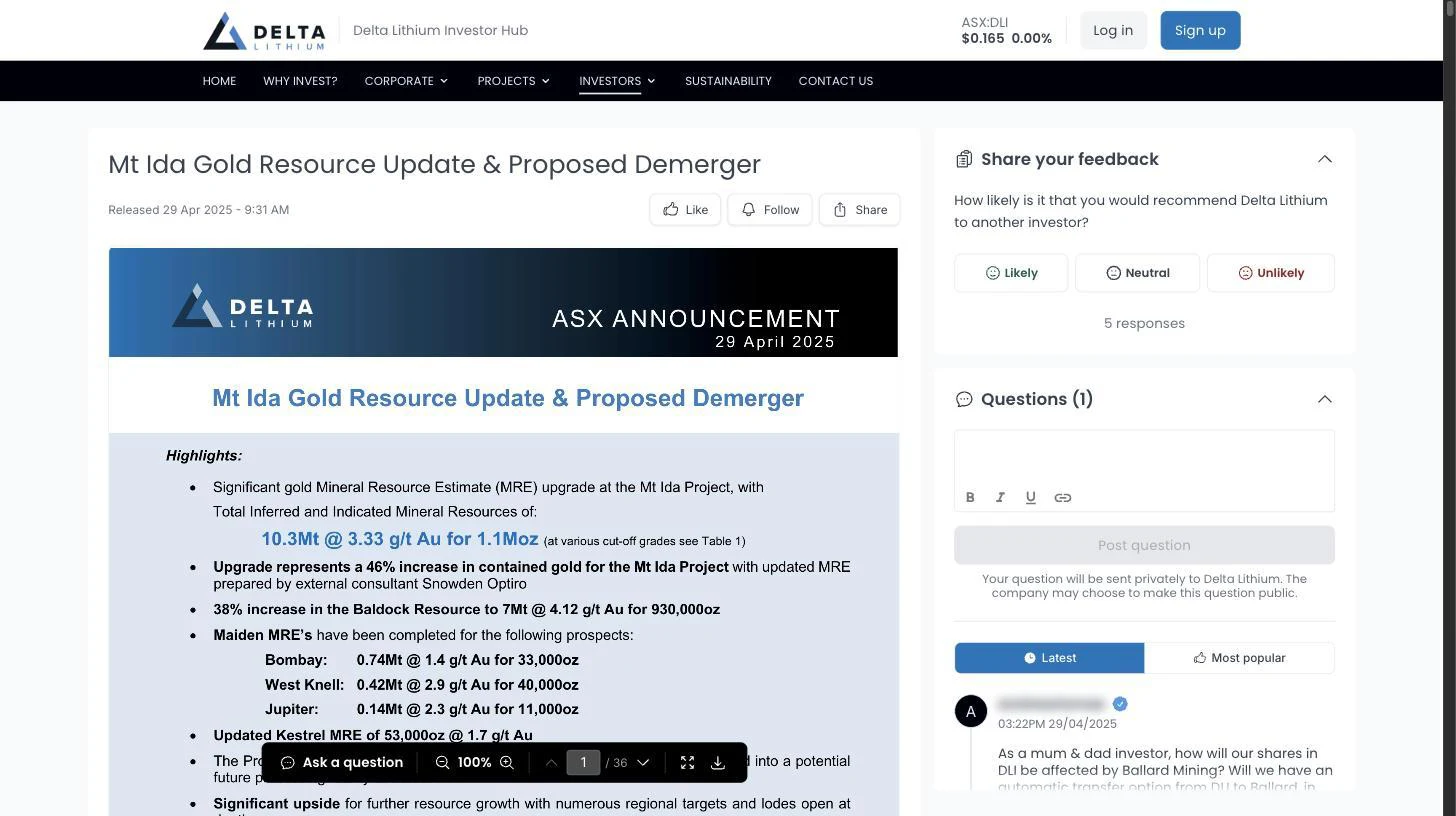
Source: Delta Lithium's hub, with the demerger announcement and investor Q&A.
- 2
Build the list before listing
Ballard's landing page went live on 2 May 2025 with sign-up forms on it, ten weeks before the company traded, and the onboarding plan was sequenced backwards from the IPO date: landing page in May, hub updated once the prospectus was final, offer run through June, then announcements, campaigns and registry integration at listing in July.
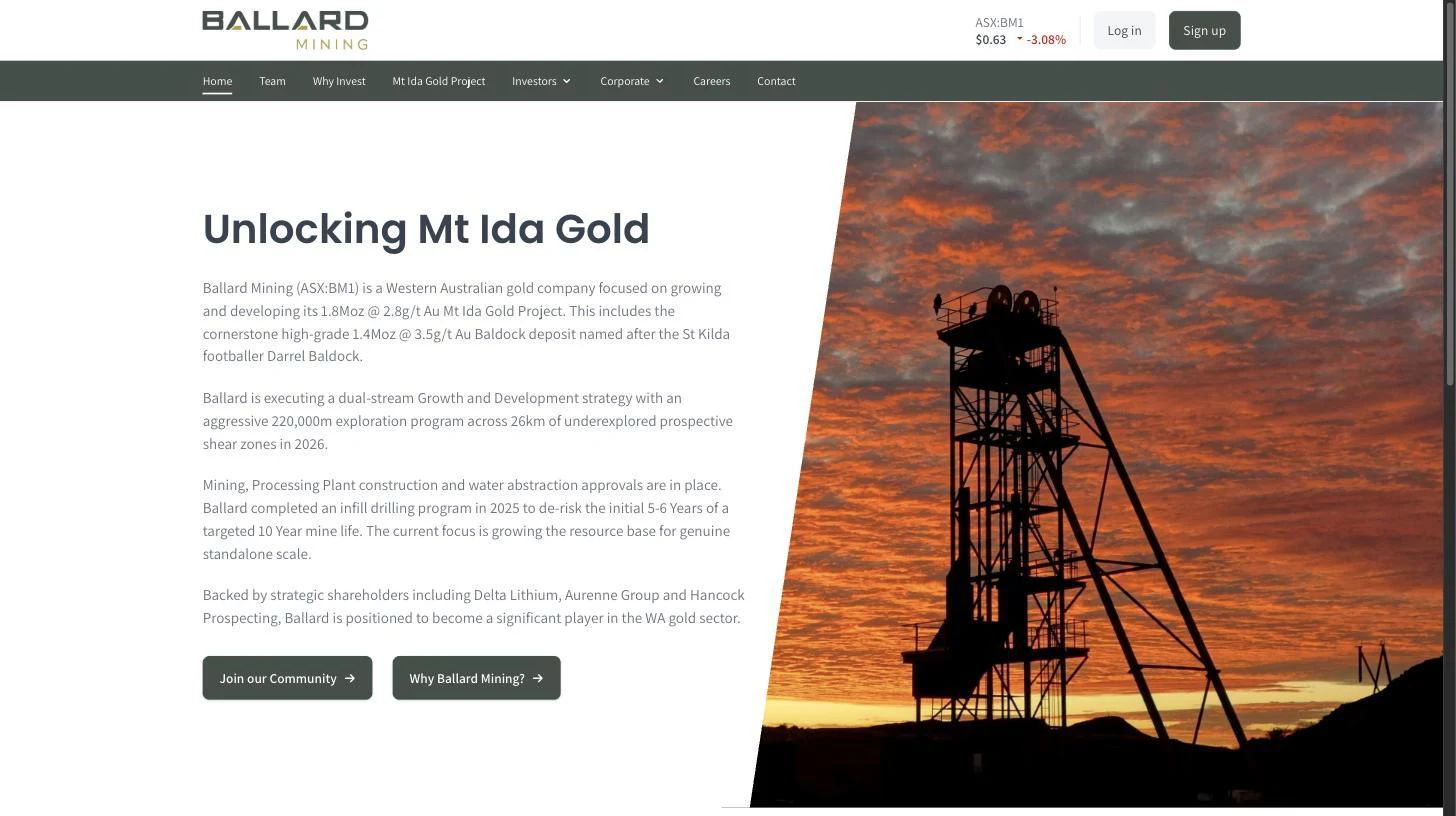
Source: Ballard Mining's investor hub home page.
- 3
Reuse what the parent already has
Webinar and video content produced for Delta was populated onto Ballard's hub as well, so one piece of content served both audiences. For a company that did not yet exist commercially, that meant a content library on day one rather than an empty shell.
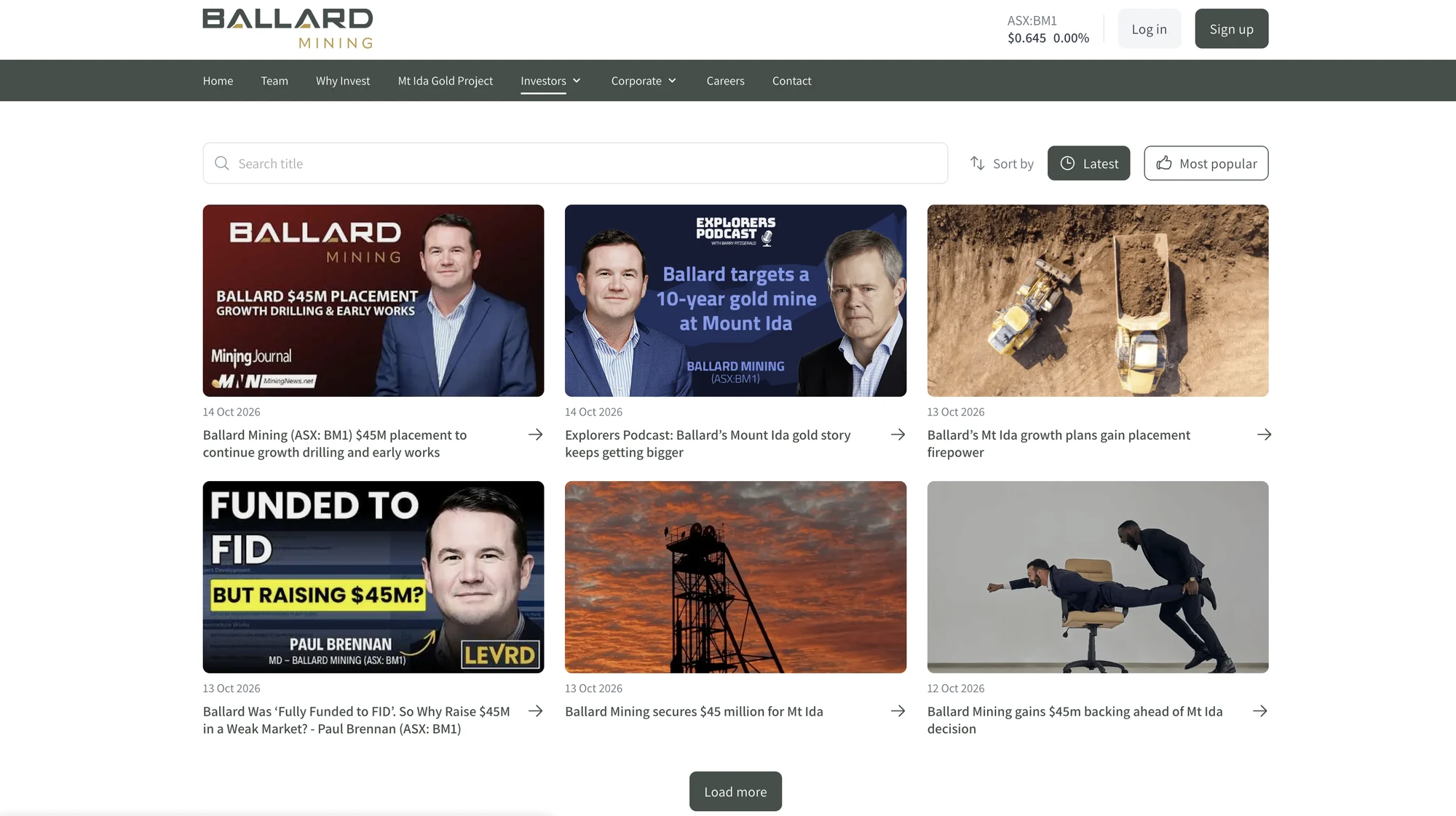
Source: Ballard Mining's News & Media library.
The flywheel
Each turn makes the next one easier.
None of these are needle moving by themselves, but together and over time they combine and grow on each other to make each move more and more impactful.
- Attract
- Reach the whole register directly, rather than the twenty holders who take the calls. More of the register hears from you, so more of it can respond.
- Understand
- Every open, read, click and question is a signal about who is actually paying attention, and to what. The register stops being a list of names.
- Engage
- Answer what shareholders actually asked, while they are still asking it. That earns the next open, which is what makes the next turn sharper than this one.
Which is why the wheel doesn’t just keep turning, it gets better at turning. The register you engage this quarter is the register you understand next quarter.